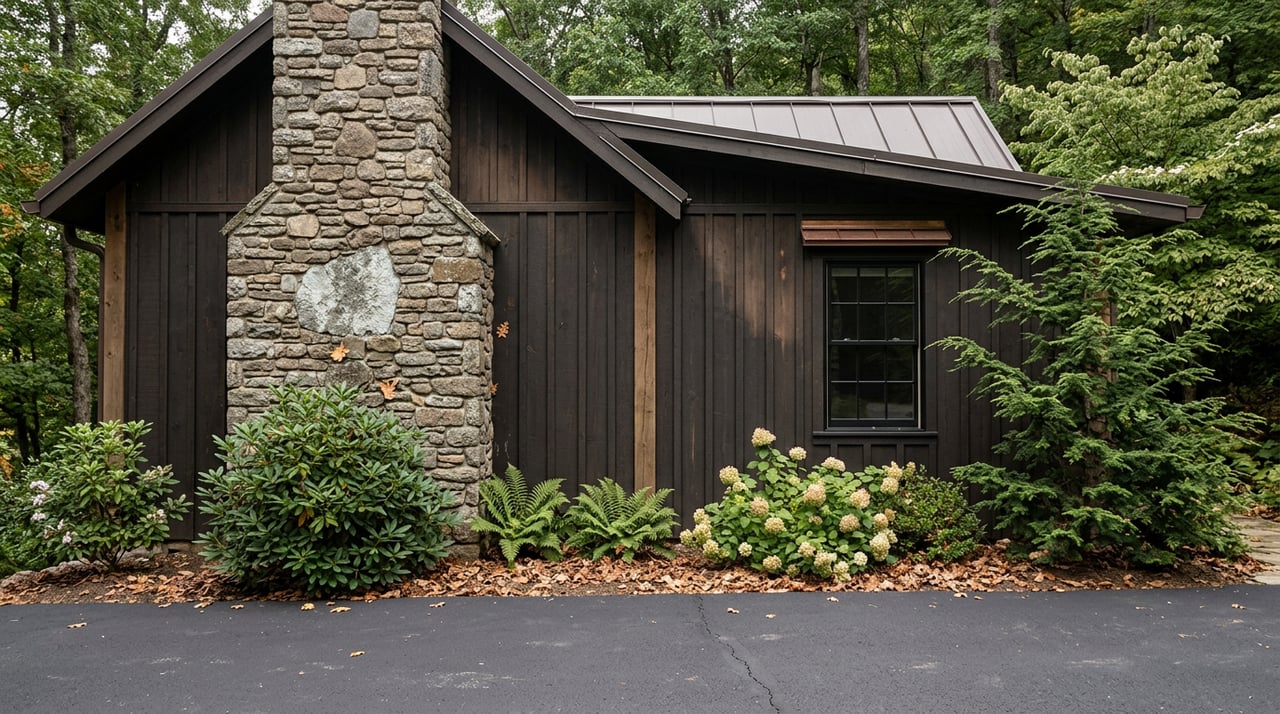
Two three-bedroom cabins sit less than four miles apart inside ZIP 30513. One is listed at $389,000 on a gravel forest-service spur with a partial winter view. The other is asking $895,000, paved to the door, Toccoa River frontage, furnished, already on a rental calendar. Same county, same bedroom count, same square footage on paper. Different products, different buyers, different math.
If you have opened Zillow, Redfin, and Realtor.com in three tabs and gotten three different "medians" for the same market, that is not a data glitch. It is the market telling you something the portals cannot summarize in one number.
Start with the friction: Fannin's STR ordinance changed in August
If short-term rental income is part of your model, the ordinance revision the Fannin County Board of Commissioners adopted on August 12, 2025 is the first thing to underwrite. It is also the fact that most out-of-town buyers, and a surprising number of rental guides published this year, still miss.
The revised Short-Term Vacation Rental Ordinance requires every rental owner and management company to register on the county's online reporting system, pay a $225 application fee, and renew the accommodation excise tax certificate by December 31 each year. Miss the renewal and there is a $25 penalty. Miss it by long enough and the certificate is treated as a new initial application, meaning full re-compliance from scratch. Sell the cabin and the new owner has a 30-day grace period to keep operating, but only if the transfer application lands within seven days of closing. The transfer fee is $50.
The ordinance is not friction for its own sake. It is a scheduling instrument. Closings that ignore the seven-day window can shut down a summer of bookings. Closings that time the transfer around it do not miss a weekend.
Layer the lodging tax on top: 8% inside the City of Blue Ridge, 6% in unincorporated Fannin County, plus Georgia's 4% state sales tax that Airbnb and VRBO typically collect and remit on the host's behalf. A cabin one road over from the city limit runs a two-point tax gap that compounds meaningfully over an ownership cycle.
At least one widely circulated 2026 STR guide still asserts that Blue Ridge and Fannin County "do not currently require STR registration." That was true a few years ago. It is not true now. Trust the county's own lodging tax page over any third-party summary, and confirm the current application packet before you write an offer.
Why the medians disagree
Once you know an STR-eligible cabin carries different carrying costs than a primary residence, the fractured median numbers start to make sense. The portals are not measuring the same market. They are measuring different slices of two markets that happen to share a ZIP code.
Realtor.com's Blue Ridge median listing price sits around $699,000, with 30513 close behind at $679,000, as of spring 2026. Zillow's Home Value Index put the typical Blue Ridge home at $506,554 on March 31, 2026, down 0.3% year over year. Redfin's March 2026 Fannin County median sale price came in at $736,000 with 113 days on market, while its Blue Ridge city-level snapshot showed an average sale under $300,000 the same month on a much smaller sample. Orchard's rolling thirty-day window in April 2026 logged a Fannin median sale of $700,000 on just 12 transactions.
Those are not contradictions. They are what happens when a market is bimodal and small. Twelve sales in a month means one $1.4M ridge-top cabin trade can move the "median" by six figures. A month heavy on entry-level cabins near county lines can drag it the other way. A useful local frame, borrowed from a practical local guide, is roughly $200K to $500K for entry-level cabins, $500K to $900K for core second-home cabins, and $1M-plus for the upper bracket. Those bands overlap in size and bedroom count. They do not overlap in what they actually are.
Even inside Fannin, liquidity varies by town more than most out-of-market buyers expect:
| Submarket | Median days on market (early 2026) |
|---|---|
| Blue Ridge / Mineral Bluff | 74 |
| Morganton | 77 |
| Epworth | 89 |
| McCaysville | 106 |
A cabin in McCaysville is not a worse cabin than one in Blue Ridge proper. It is a cabin with a thinner buyer pool, which means the same asking-price mistake compounds longer before it corrects. That matters more than the headline county median if you are the one holding the listing.
What actually sets a Blue Ridge cabin's price
Square footage is a weak predictor here. The variables that separate the $389K cabin from the $895K cabin four miles away are almost all outside the walls:
- View quality and orientation. A ridge that reads "open" in a February listing photo can screen in by June. Buyers who tour only in leaf-off season routinely overpay for winter views that disappear.
- Water frontage. Toccoa River, creek, and lake frontage command a premium that is not linear. Frontage on a consistent-water creek in Aska Adventure Area prices differently than seasonal branch frontage on the county's edge.
- Road access. Paved to the driveway is a different asset than a mile of gravel forest road with a seasonal stream crossing. Insurance carriers, appraisers, and rental guests all price this in.
- Distance to downtown Blue Ridge. Under ten minutes to the historic downtown is its own micro-submarket. It is also the distance most STR listings advertise.
- Turnkey furnishing. A furnished, photographed, calendar-ready cabin trades higher than the sum of the furniture. The premium is the summer season the new owner does not lose to setup.
None of this shows up in a per-square-foot number. All of it shows up in the transaction.
The STR pro forma, after the ordinance
For investor buyers, the underwriting question is whether the cabin can carry itself after the new compliance costs. The market performance data still supports serious investment, but not at every price point.
StaySTRA tracks 1,484 active short-term rental listings across Blue Ridge and Fannin County. As of its March 2026 read, the average listing grosses roughly $62,500 annually, the median property clears about $2,827 per month, and the top quartile pulls $4,643 or more monthly. Annualized occupancy sits near 53%. October is the peak occupancy month at 64%, driven by fall foliage from the drive market. December produces the highest average monthly revenue at $6,443, on holiday-weekend pricing. Summer months run 57–59% occupancy at $5,600 to $6,400. Even January and February hold 41–43% occupancy, which is what makes the market underwrite differently than a purely summer coastal rental.
Booking lead time averages 35.8 days with an average stay of 3.1 nights, a signal that this is a short-drive weekend market from Atlanta, Chattanooga, and Nashville rather than a fly-in destination. Compared with Gatlinburg, Blue Ridge has far fewer total listings but higher per-property revenue, which is a competition-density story more than a demand story.
Now nest the ordinance in. The $225 application fee, the annual December 31 renewal, the 6% or 8% lodging tax by geography, and the seven-day transfer window are not deal-breakers. They are line items that reward buyers who plan the transaction around them and punish those who do not.
Where underwriting quietly breaks
Two friction points catch experienced buyers off guard.
The first is HOA and deed covenants. Georgia's local-control regulatory approach means Fannin County can be permissive while your specific subdivision is not. HOA restrictions and recorded covenants are enforceable independent of county ordinance. A cabin that clears every county requirement can still be legally unrentable because of a 1998 restrictive covenant nobody in the subdivision has enforced in a decade. That covenant is enforceable the day one neighbor decides to enforce it.
The second is the appraisal-to-comp gap in a bimodal market. When the "comparable" cabin sold nine months ago at a different point in the cycle, on a different road type, without water frontage, the appraised value can lag the offer price meaningfully. That is a financing conversation to have before you write, not after.
FAQ
Is Blue Ridge a buyer's market or a seller's market in mid-2026? The portals label it a buyer's market. That is directionally true for the entry-level band, where inventory is deep and days on market run past 100 in some submarkets. It is much less true for turnkey furnished cabins on paved access with view or water, which are their own competitive bracket.
Do I need an STR certificate if the cabin is inside Blue Ridge city limits versus unincorporated Fannin? The certificate and lodging tax obligations track the property's jurisdiction. Inside the city, the lodging tax is 8%. In unincorporated Fannin, it is 6%. Both require compliance with the current county ordinance mechanics if you are renting under 30 days.
What happens to my STR certificate if I buy the cabin mid-year? The transfer application must be filed within seven days of the sale to keep the 30-day operating grace period. Miss that window and you are re-applying as a new initial applicant. This is a closing-timeline detail, not a post-closing cleanup task.
Is there a "best" time of year to buy? For price leverage, late summer and January are the softest windows on the calendar. For seeing what you are actually buying, tour in both leaf-on and leaf-off if you can. The view that sells you in March is not always the view you own in July.
The cabin market here rewards buyers who treat the transaction as a product decision rather than a square-footage decision. That is where a local advisor earns their keep, and it is how Willow & West works with second-home buyers and STR investors across the North Georgia mountain corridor. If you are weighing a specific cabin, a specific submarket, or a specific pro forma against the current ordinance and market data, request your personalized marketing plan or book a tailored consultation with Brandon and Tiffany. The number on the portal is a starting point. The real answer lives one conversation past it.